


This article was a collaboration and was written by Ryan Fortner. Please make sure to check out his publication Origins in Order!

People are fascinated by ancient ruins, and by not-so-ancient ruins it turns out. When I was in architecture school, the curriculum included an architectural history class almost every semester. If they hadn’t been “architecture classes,” we could have probably all counted it as a minor in history. One of them was a seminar-style course focused on the concept of ruin.
It was mostly about the history of western culture getting into archaeology and the custom of 18th and 19th century architects touring ancient ruins to sketch and get inspiration. However, there’s an important distinction here. Were they fascinated by ruins in the sense of old things from another time, or was it something about decay itself? Some of both, and we learned that the latter fascination has crept into the contemporary psyche and worldview in startling ways.
In my view, much of the history of western architecture can be summed up in two words:
Perfection and Subversion
It is said “history doesn’t repeat itself, but it often rhymes.“1 The history of western architecture definitely rhymes. From ancient Greece to today, there is a recurring pattern. Whatever an architectural tradition focuses on, values, and tries to perfect, when they can’t perfect it any further, they turn the other way. People question and subvert the old standard.
The Greeks mastered techniques of cutting stone into perfect geometry and intricate, lifelike shapes. No one doubted how smooth a stone could be cut anymore, so the feat became stale. Rustication, the appearance of rough, uncut rock, re-entered the pallet for the sake of contrast.
Greco-Roman culture fell, but returned to the spotlight in the Renaissance. Now the goal was to imitate the ancients to perfection. When this classical style was perfected such that one could not tell the ancient from the new, this too became dull.
Then came a style called Mannerism, where the rules were twisted and mocked, and totally new decorations evolved. From this grew Baroque and later Rococo. Here we might say that decoration was perfected. The detail of craft in stone, metal, and wood was unparalleled, but this soon became criticized as superfluous, and was also abandoned.
Architects then dabbled in one revival after another, imitating countless styles from times past. The problem was that there was no style unique to that time, only imitations of old ones, so architects again sought something new. The style that emerged from this latest abandonment was Modernism, which sought to strip every ornament away and produce a “pure, rational” architecture with no meaningless decoration, one that reflected objective meanings.
What do you suppose the next generation questioned and subverted? Well, what else but the central goal and highest standard of the previous generation? Postmodernism questions everything, even challenging objectivity itself. It rejects the “rigid blandness” of Modernism with a level of humor similar to Mannerism’s treatment of Neoclassical.
The Deconstructivist branch is probably the most extreme manifestation of Postmodern philosophy. It rejects the use of forms based on previous styles, and seeks the freedom to create without constraints, by deconstructing and tearing down, robbing symbols of meaning, robbing reality of being real.
Fascination with Ruin
Any discussion of ruins in architecture would likely start with archaeology, but the concepts of ruin, decay, and fragmentation themselves have found a place in the architecture of the present and in thoughts about the future. There are two more words that belong more to the world of philosophy than architecture, and have a lot to say about culture as a whole.
Nihilism
“[nahy-uh-liz-uhm, nee-] / ˈnaɪ əˌlɪz əm, ˈni- /
nounCultural definition
An approach to philosophy that holds that human life is meaningless and that all religions, laws, moral codes, and political systems are thoroughly empty and false. The term is from the Latin nihil, meaning “nothing.”Other definitions
1. total rejection of established laws and institutions.
2. anarchy, terrorism, or other revolutionary activity.
3. total and absolute destructiveness, especially toward the world at large and including oneself.
the power-mad nihilism that marked Hitler’s last years.4. Philosophy.
a. an extreme form of skepticism: the denial of all real existence or the possibility of an objective basis for truth.
b. nothingness or nonexistence.
5. (sometimes initial capital letter) the principles of a Russian revolutionary group, active in the latter half of the 19th century, holding that existing social and political institutions must be destroyed in order to clear the way for a new state of society and employing extreme measures, including terrorism and assassination.
6. annihilation of the self, or the individual consciousness, especially as an aspect of mystical experience.”2
Deconstructionism
“a philosophical and critical movement that questions all traditional assumptions about the ability of language to represent reality and emphasizes that a text has no stable reference or meaning.
a critical movement that questions forms, hierarchies, and assumptions that are thought to be fixed because of the language traditionally used to describe those forms, hierarchies, and assumptions.”3
Jacques Derrida (1930-2004) was an Algerian-French philosopher known for creating the “deconstruction” method for analyzing literature. In deconstruction philosophy, meanings aren’t absolute, and one of the main goals is to deconstruct dualisms and the privilege of one element over the other. “Derrida doubted every conviction of the Western philosophical tradition, beginning with the convictions of Plato.”4
Deconstructivism is the architectural counterpart to deconstructionism, but it doesn’t have a page on dictionary.com, so we’ll have to ask someone else what exactly it is. According to Phillip Johnson and Mark Wigley, who hosted the deconstructivist exhibition at the Museum of Modern Art in 1988, this style intends to “transform architecture into an agent of instability, disharmony, and insecurity, of discomfort, disorder, and conflict.”5 If this sounds similar to the page removed from the Black Lives Matter website in 2020 that read ‘We dismantle the patriarchal practice. We disrupt the Western-prescribed nuclear family structure requirement,’6 there’s a reason. Postmodern nihilism and Marxism have common roots; they’re deeply entangled today.
Well-known deconstructivists include
Peter Eisenman
Coop Himmelblau
Frank Gehry
Rem Koolhaas
Zaha Hadid
Bernard Tschumi
Daniel Libeskind
The History of the Cult of Ruins
Before Deconstructivism
The “Age of Enlightenment” in the late 17th and 18th centuries was overwhelmingly humanistic, and focused on humanity’s progress forward. The influence of these ideals persisted well into the twentieth century and became the backbone of Modernism. However, almost immediately, some began to turn and look back. The literary theorist Andreas Huyssen has written a great deal about why people look back.
“The cult of ruins has accompanied Western modernity in waves since the eighteenth century. But over the past decade and a half, a strange obsession with ruins has developed in the countries of the northern transatlantic as part of a much broader discourse about memory and trauma, genocide and war. This contemporary obsession with ruins hides a nostalgia for an earlier age that had not yet lost its power to imagine other futures. At stake is a nostalgia for modernity that dare not speak its name after acknowledging the catastrophes of the twentieth century and the lingering injuries of inner and outer colonization. Yet this nostalgia persists, straining for something lost with the ending of an earlier form of modernity. The cipher for this nostalgia is the ruin.”7
Huyssen goes on to call a very prominent branch of Modern architecture, known as the International Style, “a failed attempt to create an alternative kind of totality.” What went wrong? Just what he said:
“Memory and trauma, genocide and war.”
Postmodernism
The world wars left physical ruins, but also metaphysical ruins, psychological ruins. The decade of the 1960s is considered a turning point where people questioned the prior optimism about humanity’s future. It was a time for questioning everything. This was the birth of Postmodernism. This was the decade when popular music developed what Huyssen might call a “strange obsession” with death. Postmodern people are disillusioned by the fruits of this path their predecessors heralded as a great triumph.
“I have become death, destroyer of worlds.”
- J. Robert Oppenheimer, “father of the atomic bomb,” quoting Krishna in the Bhagavad Gītā, an ancient Hindu text.
And yet, Huyssen said the strange obsession with ruins in the context of trauma and war took off a decade and a half before his writing in 2006 — the early 1990s.
This Postmodern shift in perspective had a clear impact on architecture, dating back to the 1960s. Deconstructivism in its true form began to emerge around 1980. Postmodernism questions the rules; it questions objectivity itself. Postmodern architecture is a built manifestation of that. A building always manifests the worldview of the builder. The entry on Postmodernism found in James Curl’s “A Dictionary of Architecture and Landscape Architecture” sums it up nicely:
“Essentially, Post-Modernism has been connected with a loss of faith in what were once regarded as certainties (e.g. so-called progress, supposed rationality, and ‘scientific’ approaches to design) and with a growing acceptance of a bewilderingly large palette of images, signs, and products promoted on a scale never experienced before in the history of the world, which some (e.g. Venturi) welcomed as offering ‘complexity’ and ‘contradiction’ in design. … Post-Modernism seems to have heralded a major change in Western culture, even a new condition permeating every walk of life, involving cynicism, fragmentation, ill-digested eclecticism, and what some (e.g. F. Jameson) have called the ‘cultural logic of late capitalism’.”8
Deconstructivism
Though Deconstructivism stems from a Postmodern mindset, it is a separate architectural style with different values and beliefs. Postmodernism’s whole identity, even its name, is about its rejection of Modernism. Postmodernism sometimes imitated forms from previous styles, but Deconstructivism rejected this use of historic forms in favor of total freedom and fragmentation. All previous ideas and rules were thrown out, allowing the freedom to create without constraints.
“Architecture is making objects with no subjects.”
- Daniel Libeskind, deconstructivist architect of the Jewish Museum Berlin, dedicated to Jewish history, culture, and the Holocaust, and has the physical appearance of a giant scar, or possibly a fragmented “star of David.”9
Many projects in this era achieve a conceptual dematerialization, as though a building can be built out of ideas rather than materials. With new technology, surfaces made from obscure synthetic materials can have any texture and color. They are not recognizable as wood, brick, or metal, just as an idea of a space. 3D printing gives us freedom in making shapes impossible for other materials and methods. We are now “perfecting” this deconstructed world of no materials and no rules, seemingly apart from the natural realm.
Constructivism — a Soviet Forerunner
This is not to say that the ideas or forms of Deconstructivism are entirely without precedent. In the Soviet Union in the 1920s and early 1930s, Russian Constructivists designed based on technology and material properties. Strikingly similar to Libeskind’s approach, the Constructivists said that art and architecture do not depict a subject in the world; they are independent objects in the world with their own original identity.
World War I scared people, understandably. Constructivism was a very dynamic, disharmonious style. Modernism (the International Style) was very stable. People still generally wanted stability, so Constructivism didn’t get far. Besides, most of the world wouldn’t be interested in anything that came out of Soviet Russia anyway. However, Zaha Hadid, a Deconstructivist architect, said “What I want is to update notions [the Russian constructivists] had then, to make the idea of a new order fruitful for us. That was never tried out properly. At that time, they hoped for a new start: a new architecture would arise that would throw off all constraints and call everything into question.”10
Deconstructivism in Practice
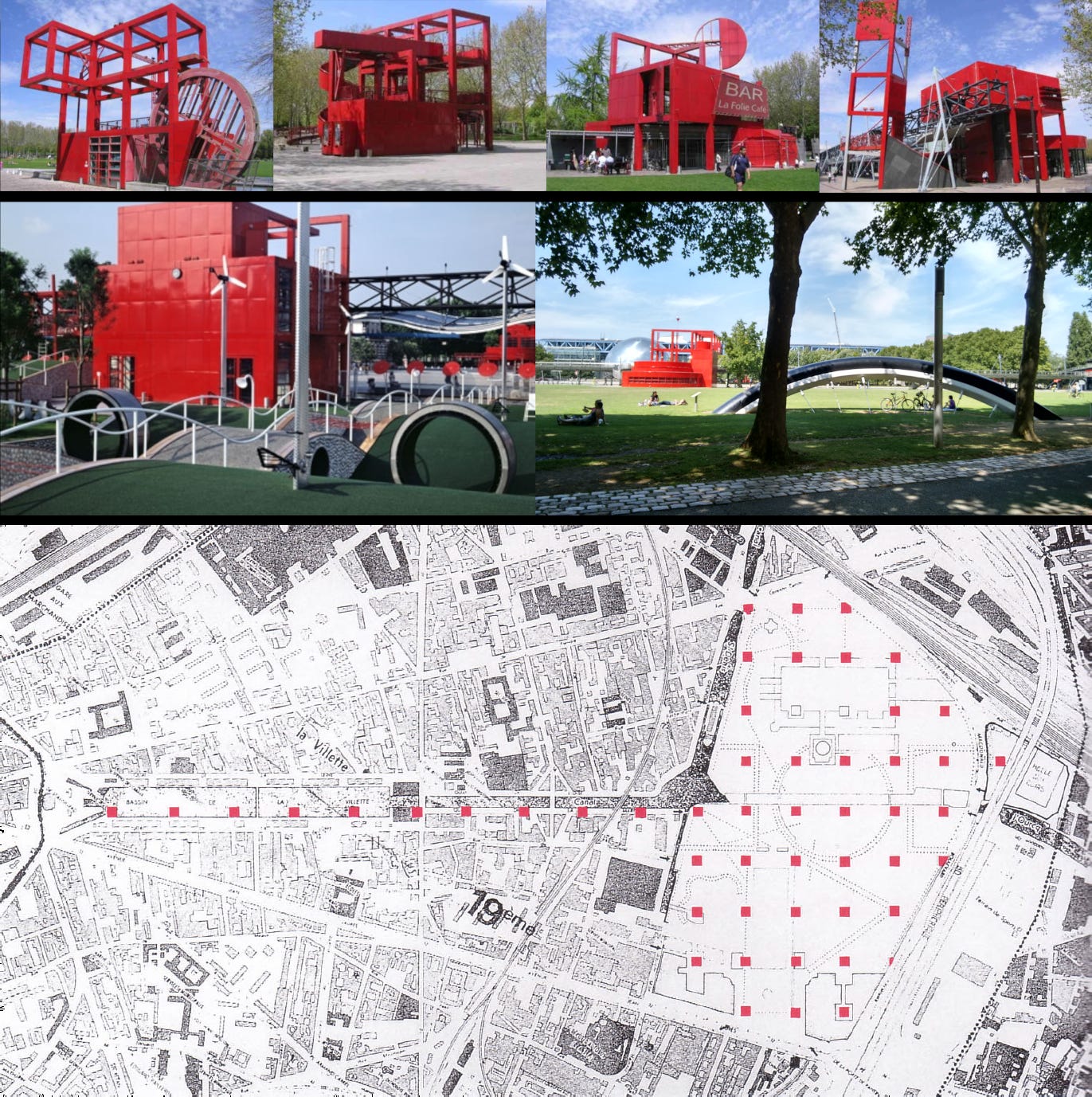
In 1982 and 1983, there was a competition to design the Parc de la Villette, a park in Paris, France. Jacques Derrida entered with architect Peter Eisenman. Bernard Tschumi won, but both entries were influential. They set the stage for Deconstructivism and introduced it to the public. Tschumi’s design features a strictly regular grid of bright red fragmented cubes. Square frames made of thick, rectangular members are prominent in many of these pieces. Other sculptures in the park include La Bicyclette ensevelie, which looks like a gigantic bicycle wheel half buried in the ground, a sort of extraordinary, imaginary ruin.
However, the Parc de la Villette was not the first truly Deconstructivist project. Frank Gehry built his house in 1978, 4 years before the Parc competition began. For comparison, Ludwig Mies van der Rohe’s “Farnsworth house” is a classic example of Modernism, and Robert Venturi’s house for his mother exemplifies Postmodernism, so we have three houses, one from each style.
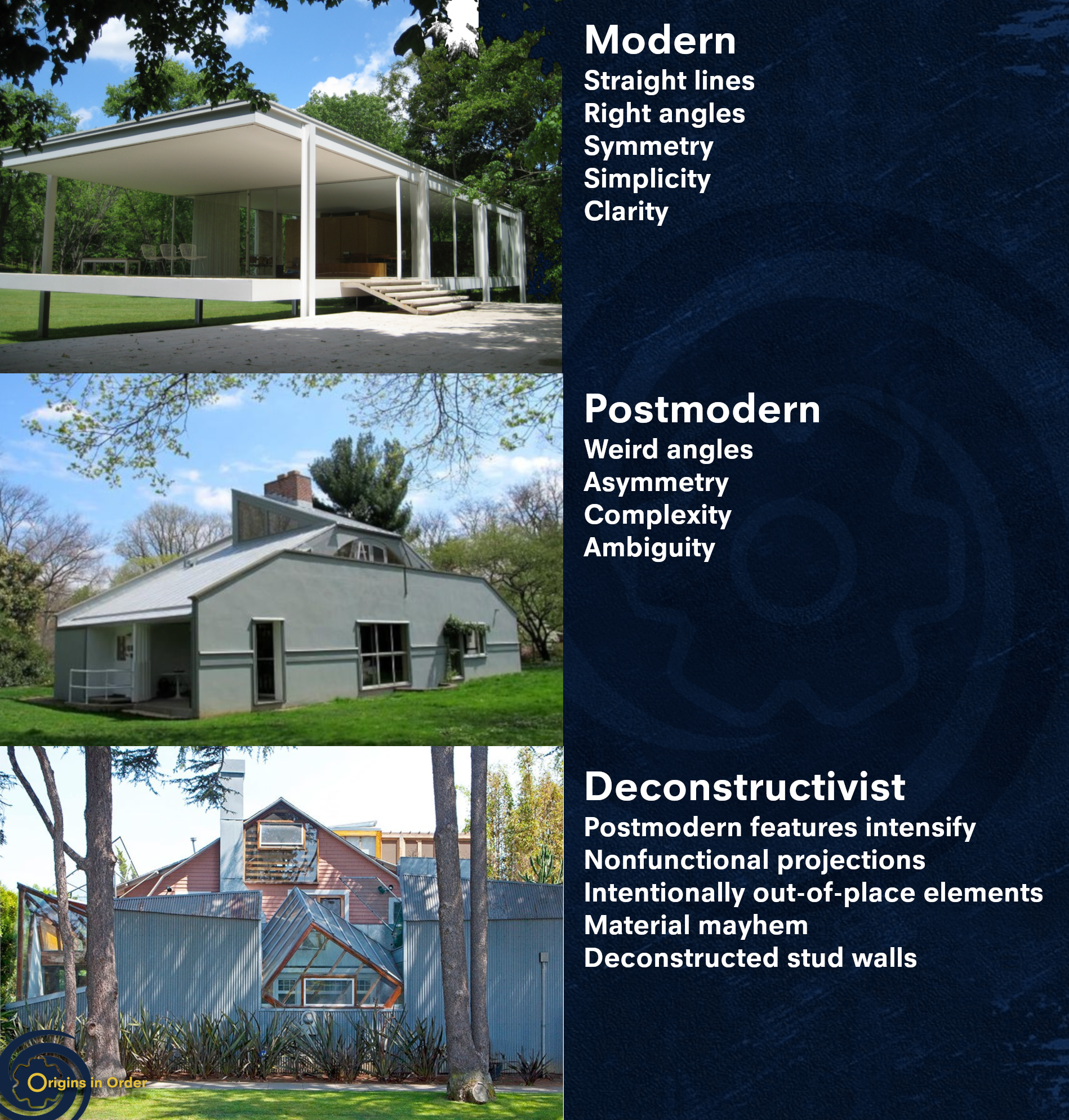
The roofs of these houses make the point nicely. The Modern house has a flat roof. The Postmodern house has an asymmetrical, complex pitched roof. The Deconstructivist house takes this so far it might be mistaken at first glance as the rubble left by a storm. Its roof is composed of several planes of different materials intersecting at different angles. Gehry’s neighbors weren’t thrilled, as evidenced by the comments compiled by John Stuart, professor of architecture at Florida International University:
“He’s imposing a piece of art on a quiet neighborhood that we may or may not like to live with.”
“It’s anti-social. The architect knew it would be offensive to people around. It’s a dirty thing to do in somebody else’s front yard. If he were a poet he’d be writing smutty jingles.”10
Venturi was a pioneer of early Postmodernism. Deconstructivists take a lot of these ideas and go further. Venturi said Modernism wasn’t mature yet. It was still too concerned with its own identity to thoughtfully respond to the needs of life. He said architecture should respond to these needs and to the complexity and irony of life.11
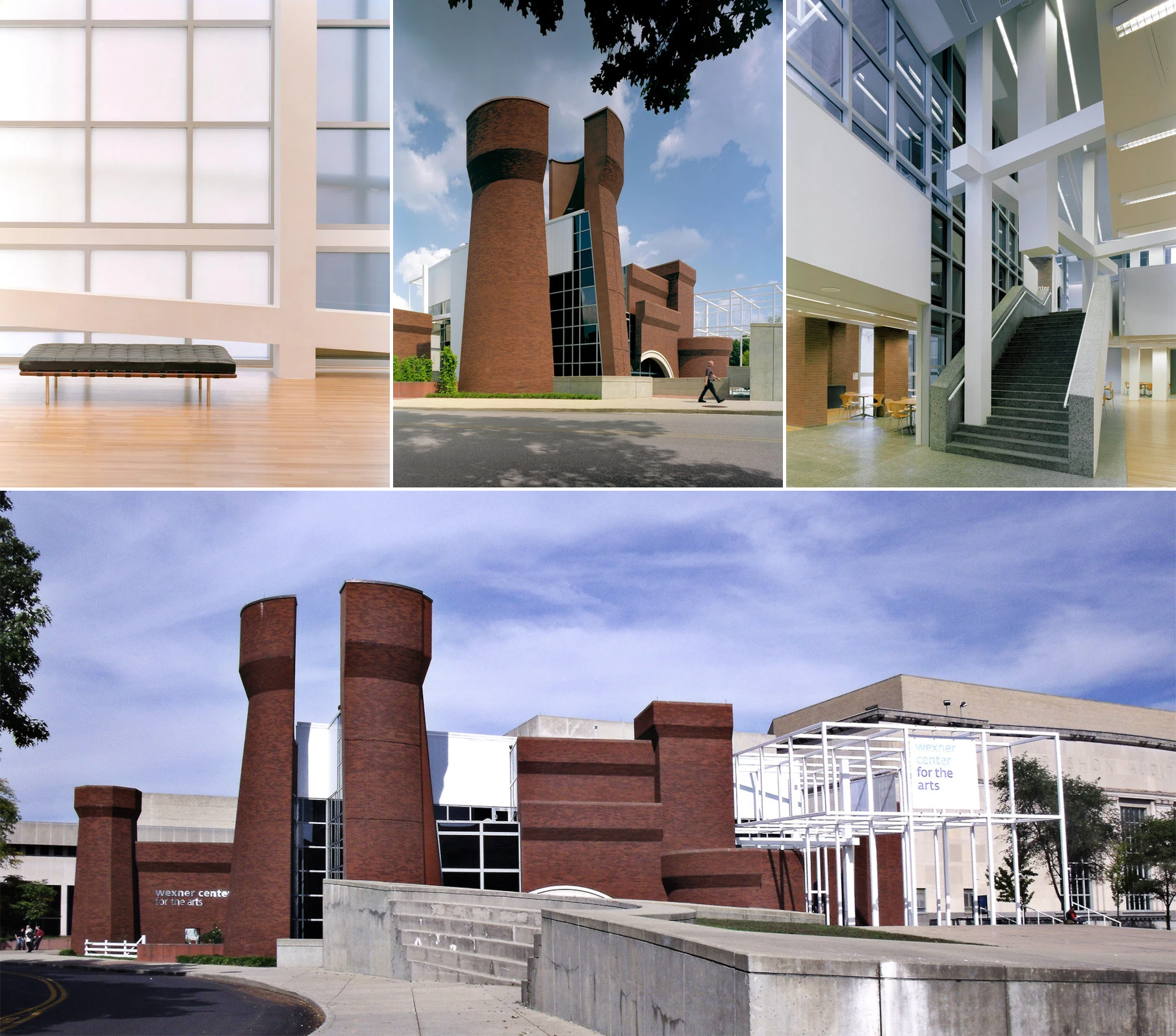
Peter Eisenman took it further still. Speaking of his design for the Wexner Center for the Performing Arts at Ohio State University, he said: “The building reflects life itself - senseless and incoherent.”12 The author Ravi Zacharias asked if the architect had deconstructed the foundation in the same way as the more visible parts. Of course, this cannot be done because it would not be structural. Deconstructivism is really a superficial instability built on top of necessary stability.
Where will we turn when we bore of pretending that objective fact is not real? We must realize that it is deconstruction that is not real. In the built environment itself, it can never be anything more than superficial. If a building appears torn apart, “senseless and incoherent” as Eisenman says, we know that in reality it is designed to work. You can deconstruct the appearance, but you dare not deconstruct the structural or mechanical systems. If carrying a philosophy to its logical conclusion causes collapse, is it useful? Is it even valid?
Eisenman’s belief about life has similar implications. If these ideas were fully expressed in all areas of life, we would see the collapse of all the objective rules of logic and morality. Objectivity in logic and even more so in morality is already under great scrutiny, and I contend that society has suffered for it. It’s no secret that people who believe that life is meaningless and free will is an illusion are more likely to be depressed. People need meaning and purpose. It will be interesting to see where this story goes next.
What Does the Obsession with Ruin Mean?
Robert Harbison, in his 1991 book “The Built, the Unbuilt, and the Unbuildable: In Pursuit of Architectural Meaning,” refers to several premodern examples of the decay obsession:
“A suspicion of crankiness hangs over the ruin-lover, like the monks who built themselves ruined cells in eighteenth-century Rome, or John Soane modelling his London house on ruins not buildings, which is to say on buildings which have failed. The justification is that our history has taken that course, and decay is part of life.”13
So ruins are “buildings that have failed.” Decay is part of life, and that this justifies embracing it. 80 years before him, the Neo-Kantian sociologist Georg Simmel believed just that:
“Here, the saying that all that is human “is taken from earth and to earth return” rises above its sad nihilism. Between the not-yet and the no-longer lies an affirmation of the spirit whose path, it is true, now no longer ascends to its peak but, satiated by the peak’s riches, descends to its home.”14
He seems to say that the human “spirit” is no spirit in the true sense, but a part of nature that will always descend back to the earth, that “its home” is annihilation. If ruin is inevitable, and this is the natural order of things, we need not be sad about it.
Personally, I have always been annoyed by this outlook because it is so anti-Christian. I have seen it in all too many books and movies that I don’t care to remember, and you have probably seen it too. Writers and characters grapple with death and decay and look for how to make it a good thing. They try to spread the message of whatever workaround they have convinced themselves of, but here’s the fact:
Death is not natural. It is the enemy. Our end is not non-existence or fragmentation. The victory is already assured.
Harbison has argued that many people “prefer shams to the truth, that the most prized forms of mental freedom require a certain insulation from reality. One becomes one’s own prisoner. Mock-ruins are thus not always a substitute or second-best for the real ones one can’t command, though for simpler minds they may be.”13
Isn’t that revealing? Yes, he’s talking about architecture in the strictest sense, but doesn’t it strike right at the heart of what’s going on in the secular world today? And at what is creeping into the Christian world simply because we lack the vocabulary to talk about it and recognize it for what it is: a rival religion.
How Far is “Too Far?”
John Soane was an 18th and 19th century architect and professor, previously mentioned in passing for modelling his house “on buildings which have failed.“ Though he went against the norms of his time, he seems to have drawn an arbitrary line somewhere. Architectural historian Robin Middleton, writing in 1999, said Soane was “advising his students that novelty must have its bounds, variety its limits. Borromini and Piranesi [architects from earlier eras], he judged, had overstepped these bounds: ‘The works of Borromini and his followers can only be looked upon as mighty mazes of chaotic confusion, wherein nothing is defined, one form constantly running into another, “Without taste, use or meaning, works frivolous, and expensive beyond measure.’”15 Soane criticized not only Piranesi, who had an affinity for the ruined and fragmented, but also Borromini, one of the most well-known architects of the decorative, decadent Baroque period.
Soane was “rebelling against established modes of thinking and building,” but thought certain other architects took it “too far.” If the whole point is rebellion, fragmentation, and destabilization, how can one even define a standard for how far “too far” is? What are the implications of a philosophy like this in a Postmodern world where people are encouraged to find their own subjective truth and create their own reality? Today, the very concepts of logic and objectivity are being deconstructed by Postmodernism, but, just as in the painted-on ruins of Rome, the deconstructors add the superficial appearance of ruins, but dare not tinker with the real structure lest all of society come crashing down in actual ruins.
At first, this phenomenon seems frivolous and surface-level, but Harbison believes the pessimism runs deep. Not intellectually deep necessarily, for Harbison says it is “sure without thinking,” and uses words like “feelings” and “taste.” He says it counts “more ancestors than descendants,“ and he frames all of this as the “disintegrating mind and collapsing principles of the age after the end of stable belief,” and calls ruins “the half-loved companions of post-religious man haunted by ghosts of faith.”13
Compare this with the entry on Deconstructivism found in “A Dictionary of Architecture and Landscape Architecture.”
“Nevertheless, some (e.g. Jencks) have claimed Deconstructivism as a new paradigm, but others have questioned the wisdom of pursuing this, mindful of the impact it is having on the built environment and on future generations of architects: those who are concerned about the legacy of Deconstructivism have perceived it as fundamentally destructive, because of its rejection of all that went before and its complete failure to provide any clear values as replacements. Indeed, Deconstructivism has been seen as intentional aggression on human senses, abusing perceptive mechanisms in order to generate anxiety and discomfort. If this is a new paradigm, it could be cause for even deeper concern.”8
Isn’t it interesting that what an architecture dictionary says about Deconstructivism is basically the same as what apologetics author Chris Wright says about nihilism in the broader sense? Wright says:
“Nihilism has eroded and destroyed more lives than any other belief on Earth because it is amoral. If nihilism is true, then anything goes. It’s an every-man-for-himself world.”16
Nihilism and the Culture War
This is all connected with the culture war we are seeing in the West, in a very specific way. Would it surprise you to learn that two of the authors I have cited, Georg Simmel from 1911 and Andreas Huyssen who is with us to this day, are associated with the Frankfurt School and critical theory? Huyssen was the one who identified the failure of reason-based Modernism as the reason for turning to ruins, and Simmel was the one who argued that nihilism and annihilation aren’t sad or negative because they are merely a return to the Earth and to nonexistence.
Remember the many definitions of nihilism? That underlying word that’s been present through this whole exploration? It “holds that human life is meaningless and that all religions, laws, moral codes, and political systems are thoroughly empty and false.”
In this word, we have the basis for deconstructionism and Deconstructivist architecture — the annihilation, destructiveness, and rejection of meaning. We have anarchy, terrorism, and revolution, even associated with specific movements. We have the basis for self-harm and occult mystical experience. We have the basis for rejecting the core teaching of Christianity — that Jesus is the way — because nothing can be absolute.
Cosmic Entropy
Entropy is why, in this universe, random data turns out to be smooth and even. The more times you flip a coin, the closer heads and tails are to equal. It is ironic that the steady, predictable rate of decay of one element into another is entirely a product of random chance. Everything becomes more like everything else as it gets bigger or runs longer. High points lower and low points rise up. Lines blur. People stop caring. Humans are willing to let each other identify as any imaginable permutation of the two genders, sometimes other things entirely.
Georg Simmel’s “The Ruin” was about why people are fascinated by architectural ruins, but his words touch so much more.
“Thus purpose and accident, nature and spirit, past and present here resolve the tension of their contrasts or, rather, preserving this tension, they yet lead to a unity of external image and internal effect. It is as though a segment of existence must collapse before it can become unresistant to all currents and powers coming from all corners of reality.”14
He describes opposing forces collapsing in on themselves and relinquishing their resistance, all of reality converging on something. It sounds like a description of entropy itself, like the hypothetical end of a universe left to run indefinitely. It will either stretch infinitely until there is no usable energy, or gravity will pull all things back in on themselves. Either way, all distinct meanings collapse and all things become equal.
The Path vs the Destination
Let’s read on:
“Perhaps this is the reason for our general fascination with decay and decadence, a fascination which goes beyond what is merely negative and degrading. The rich and many-sided culture, the unlimited impressionability, and the understanding open to everything, which are characteristic of decadent epochs, do signify this coming together of all contradictory strivings.”
Simmel is focused not on the ultimate end of this process, but on the path. He believes that a “decadent epoch” — a time in which a culture is in decay or decline — is when we see “unlimited impressionability” and openness to everything. Doesn’t that sound like the stereotypical postmodern “liberal?” It was written back in 1911 by an early “critical theory” philosopher.
The categories “conservative” and “liberal” have, I believe, very simple definitions that transcend time, space, and culture. Conservatives wish to conserve and preserve. Liberals wish to take liberties and break down. It’s in the name. In contrast, specific definitions involving policies or beliefs are inherently fluid and context-dependent. Simmel continues:
“An equalizing justice connects the uninhibited unity of all things that grow apart and against one another with the decay of those men and works of men which now can only yield, but can no longer create and maintain their own forms out of their own strength.”
He speaks of equalizing justice, decay, and old forms that can be maintained no longer. Something about that is both transcendentally liberal and eerily similar to what we conventionally call “liberal” in our context. Recall that the deconstruction method, which didn’t exist until some five decades after Simmel’s writing, seeks to equalize all things and dismantle meanings, hierarchies, and privileges. I have heard one conservative thinker, Andrew Klavan, argue that liberalism is by nature a form of decay, and ultimately is death. It is where all things are equal. It is entropy. In physics, equalization is the ultimate fate of a universe hypothetically left to run indefinitely. See how gravity pulls things down to equalize them, how moving water seems to seek a flat, simple state.
We now have an ideology that actively wants to tear down a civilization that has achieved great things and equalize every culture, even evil ones, calling them good and building them up. When the good stands up to call evil what it is, thereby pushing it farther down and reversing entropy, liberals call good evil.
“Woe to those who call evil good, and good evil” (Isaiah 5:20).
This active decay and death is a form of chaos, for if the destination of an ordered system is a simple figure like a plane or sphere without definable (read: unequal) parts, the path is chaos and entropy. Deconstructivist buildings are chaotic and intentionally disorienting. They look interesting; who can deny it? They are the decadent phase, not the ultimate expression of this philosophy carried to its natural end.
Simmel called the decadent phase the most interesting. Eisenman likes his buildings senseless and incoherent. Have they considered the destination of such a path? This obsession with decay is parasitic. It leans entirely on subverting what came before. What happens when it burns through that material and finds itself incapable of producing anything meaningful on its own? What did that dictionary say again?
“[T]hose who are concerned about the legacy of Deconstructivism have perceived it as fundamentally destructive, because of its rejection of all that went before and its complete failure to provide any clear values as replacements.”8
Nihilism Exchanges the Truth for a Lie
Is the materialistic, nihilistic view of human life and spirit described by such figures as Eisenman and Simmel causing society to lose its values?
Do people believe death is the end?
Does annihilation feel like a sacred return to a mythic naturalistic origin?
Like Soane, are Postmodern people in a rebellious mode kept in check only by a vague, subjective sense of what “too far” is?
Could intentionally disorienting architecture be reinforcing feelings of instability and hopelessness?
We are seeing the results of subjective values encouraged by thinkers like Derrida, who argued that no meanings are absolute. It seems to me that Deconstructivism is one of many manifestations of a nihilistic way of thinking, or rather, of being.
A building always manifests the worldview of the builder.
Architecture and the arts are a visual diagnostic tool. This isn’t anything revolutionary. Philosophers and architects already know how this works.
Robert Harbison said “they prefer shams to the truth, that the most prized forms of mental freedom require a certain insulation from reality. One becomes one’s own prisoner.“
They prefer shams to the truth? They are insulated from reality? Where have we heard this before?
Paul said “For time will come when they will not tolerate sound doctrine; but to have their ears tickled, they will accumulate for themselves teachers in accordance with their own desires“ (2 Timothy 4:3).
Striving for mental freedom, the lies they love make them their own prisoners? So accepting truth would be real freedom? We’ve heard that before too.
Jesus said “You will know the truth, and the truth will make you free“ (John 8:32).
So What Next?
If my perfection—subversion theory is correct, architectural styles, as a rule, must be taken to their logical extreme before a new style will dominate. They must hit a wall. In the case of Deconstructivism, we might even say it must hit rock bottom. People have to get tired of it. It has to stop being trendy. We’ve had about 60 years of this. Maybe it’s time to give another style a turn in the spotlight. Why not something like Critical Regionalism or New Contextualism?
What about at the broader philosophical, epistemological level? If lies are the problem, truth is the answer. If hopelessness is the problem, hope is the answer. So isn’t it good news that the one actual truth is also a message of hope?
“but sanctify Christ as Lord in your hearts, always ready to make a defense to everyone who asks you to give an account for the hope that is in you, yet with gentleness and reverence“ (1 Peter 3:15).
Make a defense for what? Give an account for what? Hope. The hope that is in you. The hope that can shine through the darkest nihilism because it’s true, and “the truth will make you free.”
Robert Harbison called ruins “the half-loved companions of post-religious man haunted by ghosts of faith.”11 This is a post-Christian culture. The good news is old news. But everything old is new again. Just when people are forgetting, it’s time to remind them.
People are hurting. They’re hopeless. They’re traumatized. They’re scared. They don’t all admit that. They are looking for a way to make peace with the world as they see it. They are looking for ways to embrace death and decay. Sometimes, they get a little weird. What they actually need was there all along. Someone just needs to show them.
“Quote Origin: History Does Not Repeat Itself, But It Rhymes,“ Quote Investigator (January, 2014), https://quoteinvestigator.com/2014/01/12/history-rhymes/
“Nihilism,“ dictionary.com, https://www.dictionary.com/browse/nihilism
“Deconstructionism,“ dictionary.com, https://www.dictionary.com/browse/deconstructionism
“Deconstructivism: Translation From Philosophy to Architecture,” Aida Hoteit, Canadian Social Science 11, no. 7 (July, 2015), doi:10.3968/7240
“Deconstructivist Architecture,” Philip Johnson and Mark Wigley, The Museum of Modern Art: Distributed by New York Graphic Society Books, Little Brown and Co (1988), https://assets.moma.org/documents/moma_catalogue_1813_300062863.pdf
“BLM site removes page on ‘nuclear family structure’ amid NFL vet’s criticism,“ Joshua Rhett Miller, New York Post (September, 2020), https://nypost.com/2020/09/24/blm-removes-website-language-blasting-nuclear-family-structure/
“Nostalgia for Ruins,” Andreas Huyssen, Grey Room, no. 23. MIT Press (Spring, 2006), http://www.jstor.org/stable/20442718
“A Dictionary of Architecture and Landscape Architecture” 2nd ed, James Stevens Curl, Oxford University Press (2006)
“The Poetics of Architecture: Works at Cranbrook,” Daniel Libeskind, Parametro, no.119 (August-September 1983)
“Deconstructivism,” John Stuart, History of Design from the Nineteenth Century to the Present. Lecture (August, 2012)
“Complexity and Contradiction in Architecture,” Robert Venturi, New York: The Museum of Modern Art (1966, 1979)
“Can Man Live Without God,” Ravi Zacharias, W Publishing Group (1994)
“The Built, the Unbuilt, and the Unbuildable: In Pursuit of Architectural Meaning,” Robert Harbison, MIT Press (1991), https://archive.org/details/builtunbuiltunbu0000harb/page/n3/mode/2up
“Die Ruine,” Georg Simmel, Philosophische Kultur, Gesammelte Essays, translated by David Kettler (1911)
“Soane’s Spaces and the Matter of Fragmentation,” Robin Middleton, in “John Soane, Architect: Master of Space and Light,” edited by Margaret Richardson and Mary Anne Stevens, London: Royal Academy of Arts (1999)
“The Atheist Conversion Manual,“ Chris Wright, Allegiant Faith Network (July, 2026), https://www.amazon.com/dp/B0H8R5S9GH?lv quoted in “How Not to Become a Nihilist,“ Chris Wright, Allegiant Faith Network (August, 2026),

The sensible person’s wisdom is to consider his way, but the stupidity of fools deceives them. (Proverbs 14:8)